
Norwegian Forest Cat (skogkatt)
The Norwegian Forest Cat's temperament
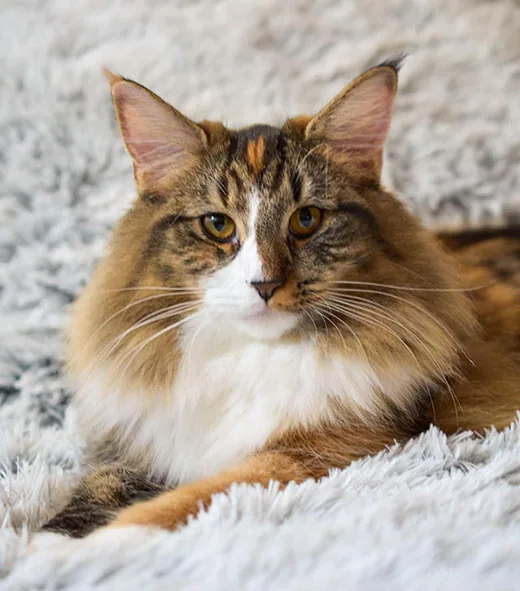
Norwegian Forest Cats are very intelligent. They become very attached to their owner and surroundings, and what matters most to them is that their owner spends time with them. A Norwegian is brave and self-confident, but can be wary of strangers – it usually needs time to accept them. These cats are friendly, active and love to be stroked. The breed is ideal for family life: as a rule they get on very well with children, dogs and other cats. They enjoy variety and love to play, but they also like quiet moments when they can take a nap.
Many Norwegian Forest Cats happily fetch and learn tricks. They are very curious and have a strong hunting instinct – it is very important to secure windows and balconies, because they may jump after a passing bird. Although they adapt to life in a flat, they enjoy walks on a lead or time in an outdoor enclosure.
History
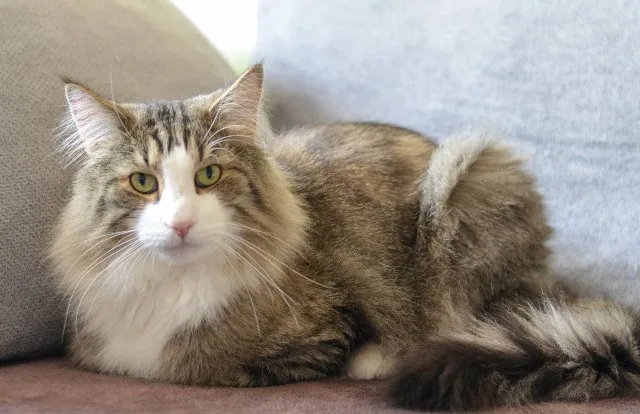
The Norwegian Forest Cat developed as a natural breed in the dense, remote forests of Norway. The harsh climate produced strong cats able to survive in difficult conditions. The first mentions of them appear in 13th-century writings and in Norse mythology. They were valued for their exceptional hunting skills and resilience to the harsh climate.
The exact origin of the Norwegian Forest Cat is unknown, as is how it came to Norway and the whole Scandinavian Peninsula. One of the best-known theories says the breed arose from crosses between shorthaired cats brought by the Vikings from Great Britain and longhaired cats that reached Scandinavia at the time of the Crusades. According to legend, Norwegian Forest Cats accompanied the Vikings on their sea voyages, guarding the supplies from rodents.
At the end of the 19th century the population of Norwegian Forest Cats began to decline due to crossing with shorthaired cats. Intensive programmes to restore the natural breed, launched in the 1930s, brought the Norwegians back. The Norwegian cat fanciers' association provisionally recognised the Norwegian Forest Cat as a separate breed in 1972. In 1977 FIFe was the first cat federation to recognise the breed. The first Norwegian Forest Cat came to Poland in 1990.
FIFe standard of the Norwegian Forest Cat
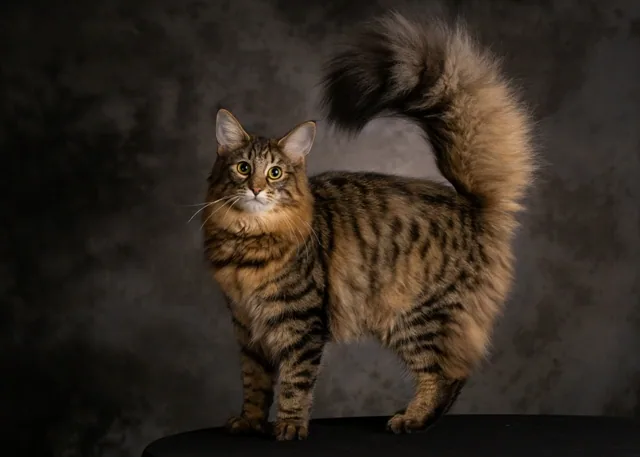
- General appearance
- A large, strong cat.
- Head
- Shape – an equilateral triangle.
- Forehead – rounded, of appropriate height.
- Chin – strong.
- Profile – straight, without a break (stop).
- Ears
- Shape – large, broad at the base, pointed, with lynx tufts, well furnished with long hair on the inside.
- Placement – set so that the outer line continues the line of the head from chin to ear.
- Eyes
- Shape – large, oval, slightly oblique.
- Expression – alert.
- Colour – all colours are allowed, regardless of coat colour.
- Body
- Body – long, strongly built, with solid bone structure.
- Legs – strong and long, the hind legs longer than the front legs.
- Paws – round, large, in proportion to the legs, with tufts between the toes.
- Tail
- Length – long, reaching at least to the shoulder blades, ideally to the neck.
- Coat
- Length – semi-long.
- Texture – a woolly undercoat covered by a smooth, water-repellent top coat of long, coarse, glossy hairs covering the back and sides. A cat in full coat has a full ruff and breeches.
- Colour – all colours are allowed (except the Himalayan pattern (colourpoint), lilac, chocolate, cinnamon and fawn), with any amount of white in any position.
- Faults
- General – too small and fine-boned.
- Head – round or square, profile with a break (stop).
- Ears – small, set too high or too wide.
- Legs – short and fine.
- Tail – short.
- Coat – dry, too silky, matted.
NFO Breed Council
Karolina Laskowska is a member of the NFO Breed Council. The list of breed councils and their official secretaries is on the FIFe website .
Reading room
Articles about the breed and FIFe World Show catalogues – read them online like a magazine.